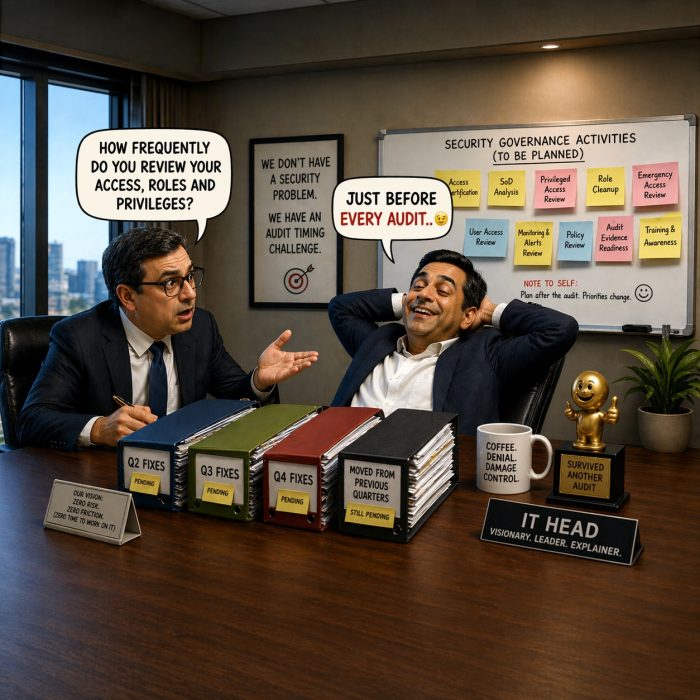
If the same SAP audit findings appear year after year, the problem is rarely the audit itself. It is usually the operating model behind your controls.
Most organizations do not fail because they lack tools, policies, or expert team. They fail because SAP security is managed reactively – reviews start just before audits, evidence is gathered under pressure, and remediation happens only after issues are exposed.
That approach creates a cycle of repeat findings, rising compliance costs, and leadership frustration. The real advantage comes from a model that operates controls continuously, prevents risks before they materialize, and keeps the organization audit-ready every day.
Across industries, organizations continue to invest in SAP platforms, transformation programs, and support services, yet still struggle with recurring issues such as Segregation of Duties (SoD) conflicts, privileged access weaknesses, delayed reviews, stale users, and inconsistent evidence trails.
Independent market research reinforces the point. In SAPinsider’s 2025 cybersecurity research, security monitoring and audit logs ranked among the most important priorities for SAP environments, highlighting how central visibility and control evidence have become for enterprise risk management. The same study also showed stronger organizations place greater emphasis on continuous monitoring, not periodic checks alone.
That distinction matters. Most recurring findings do not happen because leaders are unaware of the risks. They happen because controls are managed reactively instead of continuously.
Why SAP Audit Findings Keep Repeating
Many findings are closed tactically but not solved structurally.
A company may remediate one SoD conflict during audit season, only to recreate similar risks during the next round of provisioning. Emergency access may be approved quickly but reviewed inconsistently afterward. Access certifications may be launched, but completion quality is weak and becomes a check in the box. Evidence may exist, but only after weeks of manual collection.
These patterns are common when SAP security is treated as an administrative support function rather than a specialist governance capability.
Typical root causes include:
- User provisioning without embedded risk checks
- Manual review processes dependent on spreadsheets
- Role design that evolved without governance standards
- Weak ownership for remediation actions
- Limited visibility into critical access exposure
- Legacy controls carried into S/4HANA or hybrid cloud landscapes
- Audit preparation that starts only when auditors arrive
The result is predictable: activity happens, but assurance does not.
What to Look for in the Right SAP Security Services Partner
Selecting the right partner is not about who can close tickets fastest. It is about who can strengthen the control environment over time.
1. Deep SAP Security Expertise
SAP security is a specialist discipline. It requires experience in access governance, role design, authorization objects, SoD frameworks, privileged access controls, workflow governance, and audit evidence readiness.
Ask whether the provider has dedicated SAP security practitioners or whether security is handled as a side responsibility within a broader AMS or BASIS team.
2. Strong Audit and Compliance Understanding
A credible partner should understand how auditors assess controls: design effectiveness, operating effectiveness, evidence quality, remediation governance, and repeat-finding prevention.
Whether your priorities involve SOX, GDPR, DPDP, ISO 27001, internal audit, or customer assurance expectations, technical work must translate into defensible controls.
3. Preventive Controls, Not Just Reports
Many organizations rely on detective reporting alone. By the time a quarterly report identifies a risk, the exposure may have existed for months.
The right partner helps implement preventive controls such as:
- Risk validation during access requests
- Approval-based provisioning workflows
- Time-bound privileged access
- Automated deprovisioning triggers
- Policy checks for role changes
Prevention is cheaper, faster, and less disruptive than repeated remediation.
4. Automation Capability
If access reviews, firefighter log reviews, evidence packs, and remediation follow-ups depend entirely on manual effort, scale becomes difficult and consistency suffers.
Look for a partner that brings automation into governance operations through:
- Scheduled certification campaigns
- Auto-reminders and escalations
- Usage-based access cleanup insights
- Dashboard-driven exception management
- On-demand evidence generation
- Workflow-based controls execution
5. Continuous Operations Mindset
Audit readiness is not a once-a-year project. It is an operating discipline. The strongest partners run security governance with cadence:
- Automated risk reviews
- SLA-based remediation tracking
- Continuous monitoring of critical changes
- Quarterly certifications
- Executive control health reporting
This is how mature organizations reduce audit surprises.
6. Executive-Level Visibility
CIOs, CISOs, CFOs, and Audit Committees do not need raw transaction extracts. They need clarity on exposure, accountability, and progress.
A strong partner should provide concise insights on:
- Open high-risk findings
- Aging remediation items
- Critical access trends
- Review completion rates
- Privileged access usage
- Exceptions by entity or function
Red Flags to Watch For
Be cautious if your current or prospective provider says:
- “We handle security when needed.”
- “We’ll clean this up after go-live.”
- “Everything is manual today, but manageable.”
- “Evidence can be prepared later.”
- “One consultant covers all security needs.”
- “We support controls, but don’t track outcomes.”
These statements often indicate a reactive model that allows repeat findings to persist.
How ToggleNow SecOps Helps Transform SAP Security Services
Many enterprises already have SAP support partners, internal teams, and governance tools in place. Yet findings continue because execution is fragmented. Provisioning happens in one stream, monitoring in another, reviews somewhere else, and accountability nowhere clear.
ToggleNow SecOps changes the model.
SecOps rethinks SAP security as a continuous operating capability built around People, Process, Platform, and AI. Instead of waiting for the next audit cycle, controls are run, measured, and improved every day.
Continuous Access Governance
Provisioning, deprovisioning, approvals, role governance, and periodic reviews move into controlled workflows with measurable ownership.
Always-On Compliance Monitoring
SoD risks, dormant users, critical authorizations, stale mitigations, and policy exceptions are monitored continuously instead of being discovered late.
AI-Driven Execution
Routine tasks such as reminders, triage, evidence collection, and operational reporting can be automated, reducing repetitive manual effort and accelerating response times.
Executive Dashboards
Leadership gains board-ready visibility into control posture, remediation aging, review completion, and privileged access trends.
Specialist Ownership
Enterprises gain a dedicated SAP Security and GRC operating model focused on outcomes, not just support volume.
A Practical Example
Same SAP Landscape. Different Operating Model. Different Outcome.
| Area | Traditional Support Model | SecOps Model |
|---|---|---|
| Governance Approach | Reactive. Activity increases mainly before audits. | Continuous control execution throughout the year. |
| User Provisioning | Manual, fragmented, email-based approvals. | Automated workflow-driven provisioning with approvals and full audit trail. |
| Access Requests | Handled through tickets, emails, and follow-ups. | Standardized automated workflows with defined SLAs and accountability. |
| Segregation of Duties (SoD) | Risks identified after access is granted. Usually it’s an annual exercise. | Preventive. Checks are embedded in the solution and validated before access is approved. |
| Privileged Access | Critical roles/profiles are added to the user itself. | Time-bound privileged access with controlled approvals and structured reviews. |
| Access Reviews | Periodic, manual, resource-intensive campaigns. | Scheduled, automated, and measurable certification processes. |
| Dormant Users | Inactive accounts discovered late or during audits. | Continuous detection with automated review and cleanup actions. |
| Role Management | Role changes handled ad hoc with limited governance. | Controlled role lifecycle with approvals, versioning, and policy checks. |
| Evidence Readiness | Evidence collected manually during audit periods. | Evidence available on demand with complete activity history. |
| Monitoring | Limited visibility. Exceptions found late. | Continuous monitoring of risks, exceptions, and control health. |
| Remediation | Slow closure dependent on manual coordination. | Workflow-driven remediation with ownership tracking and escalations. |
| Executive Report | Technical or operational reports with limited insight. | Executive dashboards showing KPIs, risk trends, and open exposures. |
| Resource Utilization | Skilled teams consumed by repetitive admin work. | Automation frees teams for high-value governance and transformation work. |
| Business Impact | Repeat findings, audit fatigue, higher compliance cost. | Stronger assurance, lower risk, improved efficiency, better audit outcomes. |
What the Right Operating Model Changes Financially
Many enterprises do not need more tools first. They need a better SAP security operating model.
| Metric | Company A (Traditional Support Model) | Company B (SecOps Model) |
|---|---|---|
| SAP Version | S/4HANA | S/4HANA |
| No. of Users | Approx. 5,000 | Approx. 5,000 |
| SAP Systems | 3 systems | 3 systems |
| SAP Security & GRC Consultants | 8 resources | 3 specialists + automation |
| Monthly Access Requests | Approx. 900 | Approx. 1,400 |
| Request Handling | Manual emails / tickets | Automated workflow engine |
| Average Closure Time | 3–5 days | Same day / within SLA |
| Self-Service Options | Limited | Many |
| AI-Enforced Automation | No | Yes |
| Estimated Annual costs (approx.) | $960,000 | $360,000 |
| Estimated Annual Savings | None | $600,000 |
| Cost Reduction | None | 62% (Approx) |
Final Thought
Recurring audit findings in SAP are rarely random. They are signals that controls are being maintained tactically instead of strategically.
The right SAP Security Services Partner should do more than respond to requests. They should reduce risk, strengthen governance, improve audit readiness, and create continuous assurance across your SAP landscape.
And for organizations ready to move beyond fragmented support, a modern model like ToggleNow SecOps can help turn SAP security from an audit-season burden into a business-strength capability.
Discover More:
SAP Joule vs Claude AI: What Enterprises should know before connecting AI to SAP
Explore how ToggleNow SecOps helps modernize SAP security operations
Frequently Asked Questions
1. Why are SAP Security Services important for modern enterprises?
As SAP environments expand across S/4HANA, cloud, and hybrid landscapes, controls become more complex to manage. SAP Security Services help organizations maintain secure access, strengthen governance, reduce risk exposure, and stay prepared for audits through continuous control operations.
2. What should organizations look for in SAP Security Services providers?
The strongest SAP Security Services providers combine deep SAP expertise, compliance understanding, automation capability, measurable SLAs, proactive monitoring, and executive-level reporting. The focus should be on long-term control improvement, not just day-to-day support.
3. Can structured SAP Security Services options such as SecOps lower operational costs?
Yes. Well-designed SAP Security Services models can reduce manual effort, improve request turnaround times, optimize resource utilization, and lower the overall cost of governing access and controls through automation and standardized workflows.
4. How are modern SAP Security Services different from traditional support models?
Traditional models are often reactive and audit-driven. Modern SAP Security Services focus on continuous monitoring, preventive controls, workflow automation, self-service options, and measurable outcomes that improve both security posture and business efficiency.
5. How quickly can organizations modernize SAP Security Services?
The timeline depends on landscape complexity, user volumes, existing controls, and operating model maturity. Many organizations begin improving workflows, visibility, and governance outcomes in phased stages rather than waiting for a large transformation project.