
Why effective UAR is about better access decisions and not simply completing another workflow
User Access Reviews (UAR) are one of the most established controls in SAP access governance. They are also one of the controls most likely to create a false sense of comfort when success is measured primarily by completion.
Enterprises are required to perform User Access Reviews (UAR) periodically to satisfy governance, compliance, and audit requirements. This is mostly a quarter, semi-annual, or an annual exercise. Reviewers must validate whether users should continue to retain their assigned access, and the organization records the outcome as part of its control evidence.
On paper, the process may look successful. The review was launched, reviewers completed their tasks, exceptions were documented, and the organization achieved a 100% completion rate.
But does that necessarily mean the organization has reduced access risk?
Consider a typical User Access Review and ask yourself:
- Did reviewers receive enough information to make an informed keep, modify, or remove decision?
- How much access was actually removed or changed as part of the review cycle?
- Did the reviewers critically assess the access given to their teams or did they just check if users still work for the organization?
- Could reviewers see actual usage, risk indicators, critical access, dormancy, or licensing-related information when making their decisions?
- If the review achieved 100% completion, what actually changed in the organization’s access environment?
These questions highlight an uncomfortable reality: an organization can complete all of its reviews on time, meet its audit requirement, and still have much of the same unnecessary, excessive, or poorly governed access that was there before the review was initiated.
The problem is not necessarily that reviewers do not care about security. In many cases, they are being asked to make an access decision without enough information to make that decision confidently.
Let’s understand this with a simple example – A user is assigned a role (manager can only see a technical name and description). The reviewer knows the employee and knows that the employee works in the relevant business function. The natural response is often to approve the access. But does the reviewer know:
- What authorizations are contained in that role?
- Is the assigned access being used?
- Does the user have conflicting access elsewhere?
- Does the role provide critical or sensitive capabilities?
- Has the user’s activity changed?
- Is the user dormant?
- Is there licensing information that should influence the decision?
If those questions cannot be answered from the review itself, the reviewer is effectively being asked to certify access based on limited context and that is one of the reason a User Access Review can gradually become a check-the-box exercise.
The organization gets the evidence that a review was completed. Executives and auditors may be satisfied that the control operated as designed. Yet the underlying access risk may remain largely unchanged.
A mature UAR process therefore needs to achieve more than 100% completion. It needs to help the right reviewer make the right decision about the right access-and provide evidence that the decision resulted in meaningful action where required.
This distinction between completing a review and performing an effective access review is becoming increasingly important as SAP environments grow more complex, access populations increase, and organizations move toward continuous access governance.
The question is no longer simply whether User Access Reviews are being performed.
The more important question is: Are the User Access Reviews improving the quality of access in your SAP environment?
What a User Access Review Is Actually Supposed to Achieve
A UAR is intended to provide periodic confirmation that users continue to have appropriate access. In SAP Access Control, periodic reviews are performed by Business managers or Role owners, and the system can generate workflow-based review requests based on an organization’s control policy.
SAP documentation also describes the use of role-usage information as part of the review preparation process. A completed review can result in continued access or a request to remove access, with the review results retained for audit purposes.
The control objective is not to collect approvals. The objective is to validate access and take appropriate action. Approval is an output of the control; it is not the control’s ultimate purpose.
The Difference Between Certification and an Effective Control
Consider a typical review item: a manager sees a username, a role name and an approve/reject option. The manager may know the employee and may reasonably believe that the employee still needs access. However, the role name alone may not explain the actual authorization scope. The reviewer may not know whether the role contains critical transactions, whether the user has conflicting access elsewhere, or whether the assigned access is still being used.
This creates an important distinction between certification and validation. Certification establishes that a designated reviewer completed a decision. Validation asks whether the decision was informed, appropriate and followed by effective remediation where required.
A 100% completion rate tells you that the review finished. It does not, by itself, tell you whether access risk was reduced.
The challenges with the Conventional UAR Processes
Here are the key challenges with the conventional UAR processes:
1. The volume of access is difficult to review meaningfully
Large SAP environments can contain extensive role populations and complex user-to-role relationships. As the number of line items increases, the reviewer has less practical time to investigate each one and completes the activity without a detailed review.
2. Technical role names do not always provide business context
A business manager may understand what an employee does, but that does not mean the manager understands the implications of every SAP role assigned to that employee. Technical role names, composite roles and authorization structures can be difficult to interpret without supporting information.
3. Reviewers may not see actual usage
A role being assigned does not necessarily mean that every capability within the role is being used. Usage information can provide useful context when a reviewer is deciding whether access should remain. SAP Access Control includes role-usage and action-usage synchronization as part of the data preparation supporting UAR generation. Enterprises doing the activity in spreadsheets may not get this data.
4. Risk is not always visible at the point of review
A reviewer may approve an access assignment without seeing that the same user has another role that creates a SoD conflict, or that the access is considered critical within the organization’s control framework. A mature review therefore needs to bring relevant risk information into the decision.
5. Remediation can become disconnected from the review
If a reviewer rejects or removes an assignment, the organization also needs confidence that the change was executed and that the resulting access state reflects the decision. A control that identifies unnecessary access but does not reliably remediate it has only partially achieved its objective.
The Information Problem: Reviewers Need Context, Not Just Access
The quality of an access review is strongly influenced by the quality of information presented to the reviewer. A basic review model can be represented as:
User → Role → Approve / Reject
A more useful model is:
User → Business Context → Access → Usage → Risk → Recommendation → Decision → Remediation
The second model does not remove human accountability. It improves the information available to the person who is accountable for the decision.
What Context Should Be Available During a UAR?
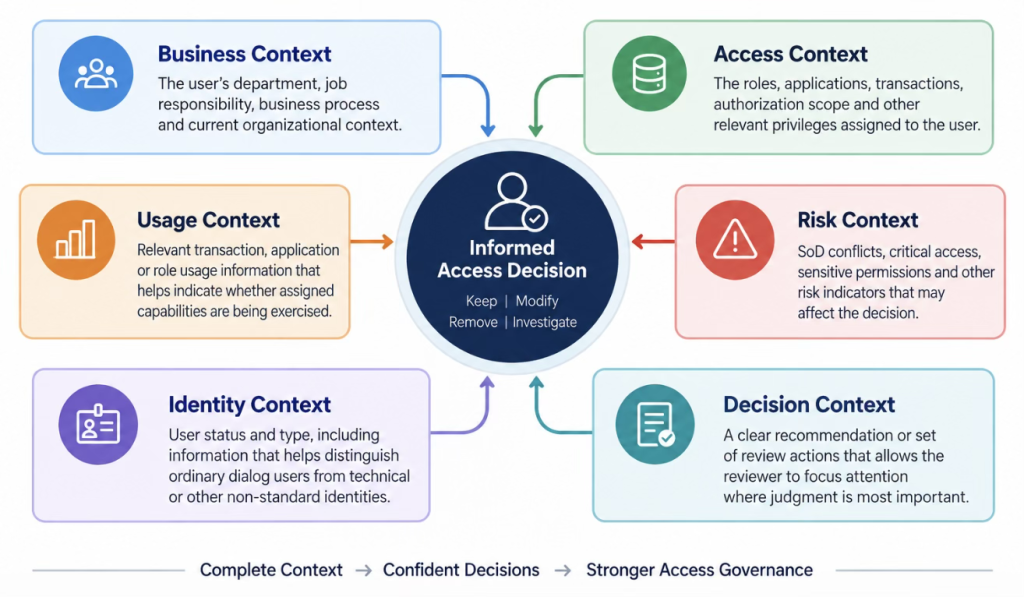
A well-designed User Access Review should offer reviewers more than just a list of users and their assigned roles. The quality of the review depends on the time of decision and the context at that time.
In our experience, there are several dimensions of context that can significantly improve the quality of a UAR. However, many enterprises still do not make this information available to reviewers as part of the review process.
Before starting a UAR, organizations should consider whether reviewers have access to the following key information:
Read more about Raghu Boddu’s experience and expertise
From Access Certification to Access Decision-Making
UAR should not be treated simply as a periodic certification campaign. It should be treated as a structured decision-making process.
- Access – What has been assigned to the user?
- Context – Why might the user need it, based on business responsibilities and organizational context?
- Usage – Which parts of the assigned access are actually being used, and what does that usage tell us?
- Risk – Does the access create SoD, critical-access or other relevant control concerns?
- Decision – Should the access be retained, removed, modified or investigated?
- Remediation – If access is no longer appropriate, has the required change been executed?
- Validation – Does the resulting access state reflect the reviewer’s decision?
Why Usage Data Can Change the Quality of a Review
Usage information is one of the most useful ways to enrich a UAR, but it is also one of the areas where organizations need to avoid simplistic rules. An access assignment that has not been used recently is not automatically unnecessary. A user may have a backup responsibility, a month-end activity, a seasonal process or an emergency responsibility that requires infrequent access.
The value of usage data is therefore not to replace human judgment. It is to improve it. Consider a user with a broad role containing capabilities that have not been exercised for a long period. That information does not prove that the role should be removed, but it provides a reason for the reviewer to investigate whether the entire role is still justified.
The same principle applies to frequently used access. Usage demonstrates activity, but activity alone does not make access appropriate. A user can actively use access that is excessive or creates an unacceptable control conflict. Usage and risk should therefore be considered together.
UAR Should Be Risk-Based, Not Just Volume-Based
A review population can contain ordinary business access alongside privileged, sensitive or conflicting access. Giving every item the same level of attention is unlikely to produce the best use of reviewer time.
A risk-aware UAR can highlight areas that deserve closer attention – for example, critical access, SoD conflicts, unusual assignments, dormant access indicators or other conditions defined by the organization’s control framework. The objective is to direct human attention toward decisions where it has the greatest security value.
AI in UAR – Where it helps, and Where It should Stop
Automation has an important role in improving UAR, particularly because much of the work surrounding a review is repetitive. Preparing data for review, collecting attributes, identifying potential risks, bringing usage data into context, prioritizing items and generating evidence can consume significant operational effort.
Those activities are good opportunities for automation. The final access decision, particularly where business context or exceptions are involved, should remain accountable to the appropriate human reviewer.
The objective of automation should be to reduce the effort required to make a good decision – not to automate a bad decision faster.
AI can assist with summarization, pattern identification, prioritization and repetitive analysis, provided its role is bounded and human accountability is preserved for consequential security and compliance decisions.
From Periodic UAR to Continuous Access Governance
A periodic UAR is inherently a point-in-time control. Access, however, changes continuously. Employees change roles, projects end, temporary access remains in place, new roles are introduced and business processes evolve.
This does not make periodic UAR obsolete. It means that UAR should be part of a broader access-governance model. Organizations can use continuous signals, such as changes in identity status, access assignments, risk conditions and usage – to identify areas that may deserve attention before the next formal review.
The longer-term objective is not necessarily to conduct a formal review every week or every month. It is to reduce the dependence on a single periodic event as the organization’s primary mechanism for identifying unnecessary access.
A Practical UAR Maturity Model
The maturity differs from enterprise to enterprise. Some focus primarily on completing the compliance requirement, while others use UAR as a risk-based, context-driven control that continuously improves the quality of user access.
The following maturity model provides a practical way to assess where an organization stands today—and identify the next step toward making UAR more effective.
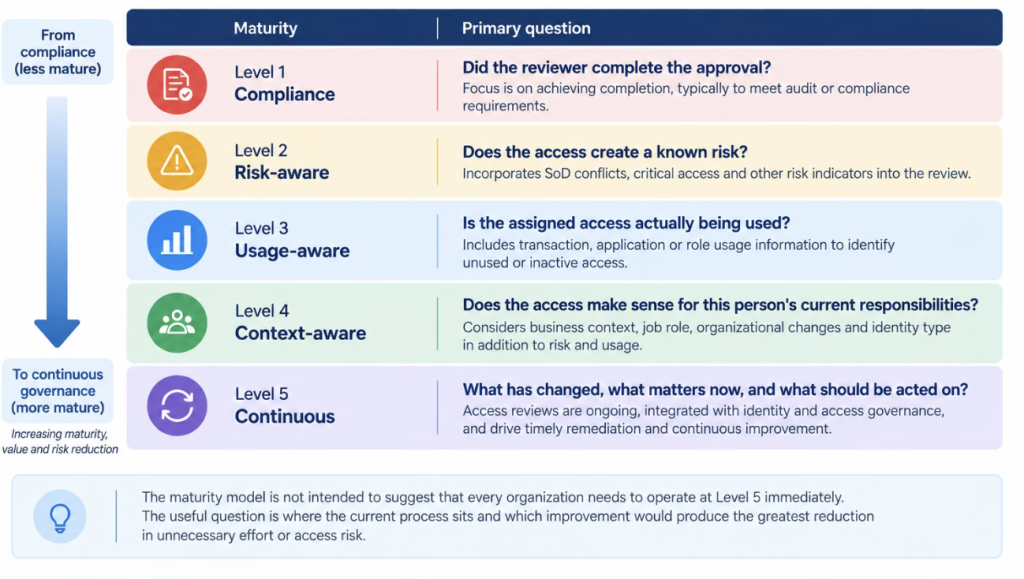
The maturity model is not intended to suggest that every organization needs to operate at Level 5 immediately. The useful question is where the current process sits and which improvement would produce the greatest reduction in unnecessary effort or access risk.
ReviewNow: Making UAR a Decision, not a Checkbox
At ToggleNow, we believe the value of an access review is determined by the quality of the decisions it produces – not simply by the number of review requests completed. That principle is central to ReviewNow, ToggleNow’s SAP Access Governance Review Platform. ReviewNow is designed to address the operational and decision-making gaps that often sit between a traditional UAR workflow and an effective access-governance control.
The objective is not to remove the reviewer from the process. It is to remove the repetitive administration around the reviewer and provide the information needed to make a defensible decision. That means automating the review lifecycle, improving the context available at the point of review, supporting different review scenarios, and producing evidence without requiring a separate manual exercise after the campaign is complete.
Put the review lifecycle on autopilot
Recurring access reviews should not depend on an administrator remembering when the next campaign needs to start. ReviewNow supports scheduled reviews that can operate in an auto-pilot mode, allowing organizations to define recurring review cycles and reduce the manual effort involved in launching each campaign. This is particularly useful for organizations managing multiple review populations, business units or control frequencies.
Automation also extends beyond campaign initiation. Auto reminders help keep reviewers moving through their assigned work, while automatic escalation can bring overdue reviews to the attention of the appropriate next level. The result is a more consistently managed review process, rather than a campaign that requires the governance team to repeatedly chase individual reviewers.
Give reviewers information they can actually use
One of the biggest weaknesses of a conventional UAR is that the reviewer is often given access information without enough context. ReviewNow is designed to bring additional data points into the review experience so that a reviewer can assess access using more than a user name and role name.
Depending on the review scenario and configured data, reviewers can consider access usage, transaction and SAP Fiori application usage, licensing-related information, dormancy indicators, SoD considerations, critical access and other relevant attributes. This does not mean that usage or dormancy should automatically determine the decision. Rather, these signals give the reviewer evidence that can support a more informed assessment.
For example, an infrequently used role may be legitimate because the employee performs a backup or periodic responsibility. Conversely, an apparently ordinary role may warrant closer examination when it provides sensitive access or contributes to an SoD conflict. The value of the data is therefore not in replacing human judgment, but in improving it.
Reduce review noise with dormancy-based rules
Review populations can contain users whose access requires a different treatment from active business users. ReviewNow can support configured exclusion of users based on dormancy levels and other defined criteria, helping organizations reduce unnecessary review volume where the control design permits it. This allows the review team to concentrate attention on populations that require an active decision while maintaining a defined governance approach for excluded users.
Treat different access risks differently
Not all access should be reviewed in exactly the same way. A mature access-governance program may require separate treatment for ordinary user access, segregation-of-duties risk, critical access, dormant users, non-dialog or technical users, emergency access and other specialized populations.
ReviewNow supports these broader review scenarios, including Critical Access Reviews, SoD-oriented reviews and other configurable review types. This allows organizations to move beyond a single generic UAR campaign and design review processes around the actual risk and governance objectives they need to address.
Support multiple stages and organizational review models
Enterprise review processes are rarely identical across organizations. Some require a manager to review access first and a role owner or control owner to perform a second validation. Others need different approval or review groups based on business unit, geography, application ownership or access type.
ReviewNow supports multiple stages and configurable groups for approvals and reviews, allowing organizations to reflect their governance model within the workflow rather than forcing every review into the same approval path. This is important because workflow flexibility is not simply a usability feature; it determines whether the technology can support the organization’s actual control design.
Validate before the review begins
A review is only as reliable as the population and ownership information behind it. Pre-Review Validation can be used to identify configured data-quality or governance conditions before review tasks are distributed, helping teams address issues such as inactive users, missing reviewers, ownership problems, duplicate records or other exceptions before they become reviewer problems.
Moving validation upstream is a relatively small process change with a significant operational benefit. Instead of discovering data-quality issues after a campaign has already started, the governance team can address them before asking business users to certify access.
Connect decisions to action and evidence
An effective UAR does not end when the reviewer selects Approve or Reject. Where access needs to be changed, the decision must translate into an appropriate remediation process. ReviewNow is designed to support remediation-oriented workflows so that the review outcome can lead to an access change, restriction or other defined follow-up action.
The final requirement is evidence. Audit teams should not have to reconstruct an access review from emails, spreadsheets and screenshots months after the campaign has finished. ReviewNow supports one-click consolidated audit reporting, giving organizations a practical way to produce evidence of the review population, decisions and related information in a form that can support audit and compliance activities.
What changes for the reviewer?
The difference can be summarized simply. A traditional review may present User → Role → Approve/Reject. A more mature ReviewNow-enabled process can provide User → Access → Usage → Risk → Context → Decision → Action → Evidence.
That is the distinction between workflow automation and decision-support automation. The first reduces the number of administrative steps. The second improves the quality of the control itself.
The goal isn’t to make the reviewer click faster. It is to help the reviewer decide better.
ReviewNow as part of a broader access-governance strategy
ReviewNow should not be viewed as a replacement for the governance principles discussed earlier in this article. It is an enabling layer that helps organizations operationalize them. Organizations can continue to leverage their existing SAP GRC Access Control investments where appropriate while using ReviewNow to extend the review experience with richer context, broader review scenarios, configurable workflows, automation and consolidated reporting.
More importantly, UAR is only one component of a broader access-governance operating model. The same organization may need SoD analysis, Critical Access Reviews, emergency access governance, dormant-user controls, security monitoring, remediation and ongoing risk assessment. This is where ReviewNow fits into the wider ToggleNow portfolio and the broader ToggleNow SecOps approach: UAR becomes one managed control within a continuous access-governance lifecycle rather than an isolated annual or quarterly certification exercise.
The Questions Organizations Should Ask About Their UAR
- How much of the review population is approved without additional investigation?
- Can reviewers see meaningful information about what the assigned roles actually provide?
- Is relevant usage information available when a reviewer needs it?
- Are critical and high-risk assignments clearly identified?
- Can the organization distinguish unnecessary access from legitimate infrequently used access?
- How quickly is rejected access actually removed?
- Can the organization demonstrate the remediation that followed the review?
- How much manual effort is required to prepare, execute and evidence the review?
- What changed in the access environment because of the last UAR?
Conclusion: Measure the Control by What Changes, Not Just What Gets Approved
User Access Reviews remain an important part of SAP access governance. The challenge is not whether organizations should perform them; it is whether the review process is capable of producing meaningful access decisions.
A process that reaches 100% completion but gives reviewers little context, treats all access equally, provides limited visibility into usage and does not reliably connect decisions to remediation can satisfy a procedural requirement without delivering the security outcome the control was intended to achieve.
The better approach is to enrich the review with business context, access details, usage, risk indicators and clear remediation. Automation should remove repetitive work and focus human attention where judgment matters. Over time, periodic UAR should become one component of a broader continuous access-governance model.
The objective of UAR should not be to achieve 100% approval completion. It should be to ensure that the right people have the right access for the right reasons, and that the organization can prove it.
Source Notes
SAP Help Portal documentation was used to validate statements about SAP Access Control UAR, including reviewer roles, periodic review workflow, review preparation, role/action usage synchronization, and review/remediation processes: