
Implementing an SAP SoD Analyzer is often viewed as the finish line in an organization’s access governance journey. After months of planning, workshops, configuration, and testing, the solution goes live, reports begin to populate, and stakeholders often believe that access risks are now under control.
In practice, that isn’t what usually happens. The momentum and enthusiasm that organizations experience during the initial SoD implementation and go-live gradually decline over time. As new projects emerge, business priorities shift, operational demands increase, and business users push back on remediation activities, SoD governance often takes a back seat.
“An SAP SoD Analyzer identifies access risks. It does not reduce them. The real access governance journey begins after go-live.”
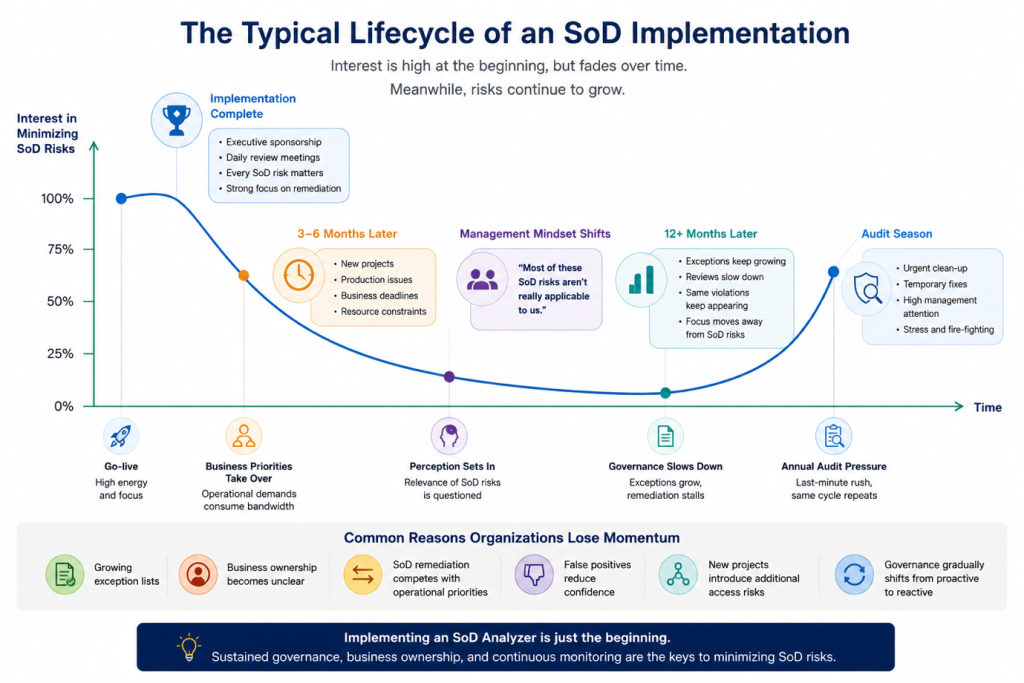
The illustration above reflects a lifecycle we’ve repeatedly observed across SAP implementations.
In reality, go-live is where the real work begins.
During more than two decades of SAP Security and GRC implementations, we’ve observed one recurring pattern regardless of industry, geography, or organization size.
Thousands of Segregation of Duties (SoD) violations remain unresolved, exception lists continue to grow, and auditors keep raising familiar observations during every audit cycle.
The technology does exactly what it is designed to do. The governance process, however, often falls behind. The reason is straightforward. An SAP SoD Analyzer performs one critical function exceptionally well: it identifies access risks. It does not decide whether those risks are acceptable, remove conflicting authorizations, redesign business roles, or ensure corrective actions are taken. Those responsibilities belong to people, processes, and governance.
What Does an SAP SoD Analyzer Really Do?
An SAP SoD Analysis solution evaluates user authorizations and identifies combinations of access that violate segregation of duties principles. For example, it can detect situations where the same user is able to create a vendor and process payments, create purchase orders and approve them, or maintain sensitive master data while executing financial transactions.
Without automation, identifying these conflicts across thousands of users and roles would be nearly impossible. Modern SoD solutions enable organizations to analyze entire SAP environments in minutes, providing valuable visibility into access risks that support compliance, internal controls, and audit readiness.
However, identifying a risk is fundamentally different from reducing one. This distinction is where many organizations unintentionally fall short.
Why Organizations Continue to Struggle After Implementation
I still remember one customer where the first SoD analysis generated nearly 18,000 violations. The client team initially assumed the implementation had failed. In reality, the tool was doing exactly what it was supposed to do – it was exposing years of accumulated access that had never been reviewed. The real challenge wasn’t the number of violations; it was deciding where to begin.
The initial risk analysis often uncovers years of accumulated access resulting from employee transfers, temporary project assignments, emergency access, acquisitions, and evolving business responsibilities. While the volume of violations can be overwhelming, it doesn’t necessarily indicate poor security. Instead, it highlights the absence of an ongoing governance process.
Without clearly defined ownership, many organizations generate reports every month but take very little corrective action. Security teams distribute findings, business users acknowledge them, and the same violations continue appearing in subsequent reports. Over time, the SoD Analyzer becomes a reporting tool rather than a governance solution.
The tool continues doing exactly what it was designed to do. Unfortunately, the organization gradually stops acting on the insights it provides.
A Tool Is Only as Effective as the Governance Around It
An SAP SoD Analyzer should never operate in isolation. Its effectiveness depends entirely on the governance framework supporting it.
One of the first areas that deserves attention is the quality of the SoD ruleset itself. During one of our SAP Security engagements, we encountered an organization where the SoD ruleset had been defined internally by an experienced IT team that had supported the business for over two decades. Rather than using business processes as the foundation, the team had identified risks based primarily on technical authorizations and simple transaction-level analysis using SAP’s standard reporting tools such as SUIM.
While this approach reflected deep technical knowledge of the SAP environment, our assessment revealed that many of the identified conflicts represented IT risks rather than true business risks. More importantly, several critical business process conflicts were not captured because the ruleset was not aligned with how business activities were actually performed across functions.
This is a common challenge. Many organizations either rely on the standard rulesets delivered by software vendors and consulting partners or build their own rulesets based solely on technical authorizations. While these approaches provide a useful starting point, they rarely reflect the organization’s unique business processes, custom transactions, organizational structure, or industry-specific controls. As a result, security teams spend considerable time investigating false positives while genuine business risks may remain undetected.
During another implementation, a business owner confidently told us, “Most of these SoD risks don’t apply to our business.” Six months later, during an internal audit, many of those same “irrelevant” risks had to be reviewed and formally justified. The lesson wasn’t that the SoD Analyzer was wrong – it was that every identified risk deserves a business decision, whether that decision is remediation or documented acceptance.
In almost every implementation I’ve participated in, the first discussion isn’t about the tool. It’s about the rules. Business teams insist certain conflicts are “normal,” auditors expect stricter controls, and security teams find themselves somewhere in the middle. That’s why I often say an SoD ruleset is never finished – it evolves as the business evolves.
A mature SoD program treats the ruleset as a living asset that evolves with the business. Periodic reviews involving both business process owners and SAP security teams help ensure that the ruleset continues to identify the risks that matter most to the organization – not just technical conflicts.
The ruleset should therefore evolve alongside the business. New applications, organizational changes, regulatory requirements, and business processes all influence what constitutes an unacceptable risk. Organizations that periodically review and refine their rules achieve far more meaningful analysis than those relying on static configurations established during implementation.
Another pattern I’ve observed is that unresolved SoD violations rarely stem from technology. More often, they result from unclear ownership.
Equally important is establishing clear accountability. Technology can identify conflicting access, but it cannot determine whether that access remains justified. Those decisions require business knowledge. Process owners understand operational requirements, managers understand employee responsibilities, and risk owners understand the organization’s tolerance for exceptions. When accountability is unclear, violations remain unresolved regardless of how sophisticated the technology may be.
Exception Management Should Support Governance - Not Replace It
Every mature access governance program recognizes that exceptions are sometimes necessary. Business-critical projects, production support activities, mergers, acquisitions, and emergency situations may require temporary access that introduces SoD conflicts.
The challenge arises when exceptions become the default response instead of remediation.
We’ve encountered organizations where temporary exceptions remained active for years simply because no structured review process existed after implementation. What was originally approved for a three-month project gradually became permanent access, increasing business risk without anyone realizing it.
An effective exception management process ensures that every accepted risk has documented business justification, appropriate approvals, compensating controls where necessary, and a defined review or expiration date. Exceptions should enable business continuity—not become a substitute for good role design.
Continuous Monitoring Is More Valuable Than Periodic Reviews
One mistake I repeatedly see is organizations treating access governance as a project rather than an ongoing operational process.
Employees change departments. New business processes are introduced. Consultants join projects. Sensitive responsibilities shift across teams. Every one of these changes has the potential to create new Segregation of Duties conflicts.
Organizations that perform SoD analysis only during annual audits or major implementation projects often discover issues months after they have already existed in production.
Continuous monitoring fundamentally changes this approach. Rather than waiting for the next audit cycle, organizations can identify newly introduced risks soon after access changes occur, significantly reducing the time that excessive privileges remain active. More importantly, continuous monitoring encourages proactive governance instead of reactive remediation.
Measuring the Success of an SAP SoD Program
One of the biggest mistakes organizations make is measuring the success of an SAP SoD Analyzer by the number of violations it identifies.
A report showing 20,000 violations doesn’t necessarily indicate poor security. In many cases, it simply reflects years of accumulated access that has never been reviewed.
A more meaningful measure of success focuses on business outcomes.
Are critical risks being eliminated?
Are recurring violations decreasing over time?
Are conflicting roles being redesigned?
Are business owners resolving risks within defined timelines?
Are unnecessary authorizations being removed before they become audit findings?
These questions shift the conversation from reporting to risk reduction.
Ultimately, an SoD Analyzer should not be judged by the number of reports it generates, but by its ability to drive better governance decisions across the organization.
One lesson we’ve learned repeatedly is that organizations rarely fail because they chose the wrong SoD solution. They struggle because governance loses momentum after implementation. The most successful organizations aren’t the ones with the fewest SoD violations on day one – they’re the ones that consistently review, remediate, and refine their access governance program year after year.
Looking Beyond SAP SoD Analyzer Implementation
An SAP SoD Analyzer is one of the most valuable components of an access governance program, but it should never be mistaken for the program itself.
The organizations that achieve lasting improvements in security and compliance are not necessarily those with the most advanced technology. They are the ones that combine technology with business accountability, well-designed governance processes, continuous monitoring, regular role optimization, and a culture of ongoing improvement.
Technology can identify access risks within minutes. Deciding what to do about those risks is where governance begins.
That is where the real value of an SAP SoD Analyzer is realized – not at implementation, but in everything that follows.
After more than two decades of implementing SAP Security and GRC solutions, one lesson continues to stand out: organizations rarely struggle because they lack the right tools—they struggle because governance loses momentum after go-live. An SAP SoD Analyzer provides the visibility. Sustained governance delivers the value.
An SAP SoD Analyzer is an essential component of an effective SAP Access Governance strategy, but implementing the tool alone does not reduce business risk. While it accurately identifies Segregation of Duties (SoD) violations, organizations often struggle after go-live because of outdated rulesets, unclear ownership, growing exception lists, shifting business priorities, and the absence of continuous governance.
To maximize the value of an SAP SoD Analyzer, organizations must go beyond implementation and establish a mature governance framework. This includes maintaining business-aligned SoD rules, continuously monitoring access risks, assigning accountability for remediation, periodically reviewing exceptions, optimizing role design, and measuring success based on risk reduction rather than the number of violations identified.
Ultimately, the success of an SoD program depends not on how many risks are detected, but on how effectively those risks are governed, remediated, and prevented over time. Organizations that combine technology with strong governance processes achieve better compliance, stronger internal controls, and a more resilient SAP security posture.
TL;DR
An SAP SoD Analyzer identifies access risks - it does not eliminate them. Sustainable SAP access governance requires business ownership, a well-designed SoD ruleset, continuous monitoring, exception management, and ongoing remediation. The real value of an SoD Analyzer is realized not at implementation, but through the governance processes that follow.
Key Takeaways
The key message is simple. An SAP SoD Analyzer helps organizations identify access risks, but technology alone cannot reduce them. Sustainable access governance requires business ownership, well-designed rulesets, continuous monitoring, timely remediation, and periodic reviews. Organizations that combine these practices with the right technology build stronger internal controls and realize the full value of their SoD investment.
Continue Your SAP Access Governance Journey
If you found this article useful, you may also be interested in:
- SAP Access Governance Three Checks Before Role Assignment
- What to Look for in the Right SAP Security Services Partner
- Understanding SAP SoD Analyzer Fundamentals
- Designing Business-Centric SoD Rulesets
- Reducing False Positives in SoD Analysis
- Building a Sustainable SAP Access Governance Framework
- Preparing for SAP Security and GRC Audits
- Best Practices for SAP Role Design
- Conducting Effective SAP User Access Reviews
- Managing SoD Exceptions Without Increasing Business Risk
Frequently Asked Questions
1. What is an SAP SoD Analyzer?
An SAP SoD Analyzer is a security and governance solution that identifies Segregation of Duties (SoD) conflicts within SAP systems. It analyzes user authorizations, roles, and access combinations to detect situations where a single user can perform incompatible business functions, helping organizations strengthen internal controls, improve compliance, and reduce fraud risk.
2. Is implementing an SAP SoD Analyzer enough to achieve compliance?
No. An SAP SoD Analyzer identifies conflicting access and supports compliance initiatives, but organizations still need governance processes, business ownership, remediation workflows, exception management, and continuous monitoring to effectively reduce access risks.
3. How often should SoD analysis be performed?
While periodic reviews remain valuable, leading organizations increasingly adopt continuous or scheduled monitoring so that new access risks can be identified and addressed soon after changes occur.
4. Why do SoD violations continue to increase after implementation?
In most cases, violations grow because user access continuously changes as employees move roles, projects begin, organizational structures evolve, and new authorizations are assigned. Without ongoing governance and regular remediation, violations naturally accumulate over time.
5. What are the most common reasons SoD implementations fail?
Most SoD implementations struggle because organizations treat implementation as the end of the project rather than the beginning of governance. Common challenges include outdated rulesets, excessive false positives, lack of business ownership, poor exception management, limited remediation, and competing business priorities.
6. What is the difference between technical risks and business risks in SoD?
Technical risks focus on individual transactions or authorizations, while business risks consider the end-to-end business process. An effective SoD ruleset should identify business process conflicts, such as the ability to create and approve the same transaction, rather than simply highlighting unrelated technical permissions.
7. How can organizations reduce false positives in SoD analysis?
8. What should organizations do after implementing an SAP SoD Analyzer?
Implementation should be followed by authorization cleanup, role redesign, SoD remediation, business ownership assignment, exception governance, continuous monitoring, periodic access reviews, and regular optimization of the SoD ruleset. These activities ensure that identified risks are actually reduced rather than simply reported.
9. How do you measure the success of an SAP SoD program?
The success of an SAP SoD program should be measured by business outcomes rather than the number of violations identified. Key indicators include reduced critical risks, faster remediation, improved role design, fewer recurring violations, effective exception management, and stronger compliance with internal controls.
10. What are the key components of an effective SAP Access Governance program?
A mature SAP Access Governance program combines an SAP SoD Analyzer with business-driven governance. Core components include a well-maintained SoD ruleset, role optimization, continuous risk monitoring, business ownership, periodic access reviews, exception management, and ongoing remediation to ensure long-term compliance and reduced business risk.
11. Does an SAP SoD Analyzer automatically remediate SoD violations?
No. An SAP SoD Analyzer identifies conflicting access but does not automatically remove risks. Organizations must review violations, redesign roles where necessary, implement compensating controls, and continuously monitor access changes to reduce business risk.
12. What should organizations do before implementing an SAP SoD Analyzer?
Before implementation, organizations should review their role design, clean up obsolete authorizations, define business-specific SoD rules, and establish governance processes for remediation and exception management. Preparing these foundations significantly improves the effectiveness of the implementation.
13. Can an SAP SoD Analyzer prevent fraud?
No. An SAP SoD Analyzer helps identify access combinations that could increase fraud risk, but preventing fraud requires a combination of preventive controls, business approvals, monitoring, detective controls, and timely remediation.
At ToggleNow, we’ve helped organizations across industries transform their SoD initiatives into mature access governance programs. Whether you’re starting with thousands of existing violations or looking to improve an already implemented SoD solution, our SAP Security and GRC experts can help your organization realize the full value of your SAP SoD investment while continuously reducing business risk.
Don’t let your SAP SoD Analyzer become just another reporting tool. Turn it into the foundation of a mature access governance program.